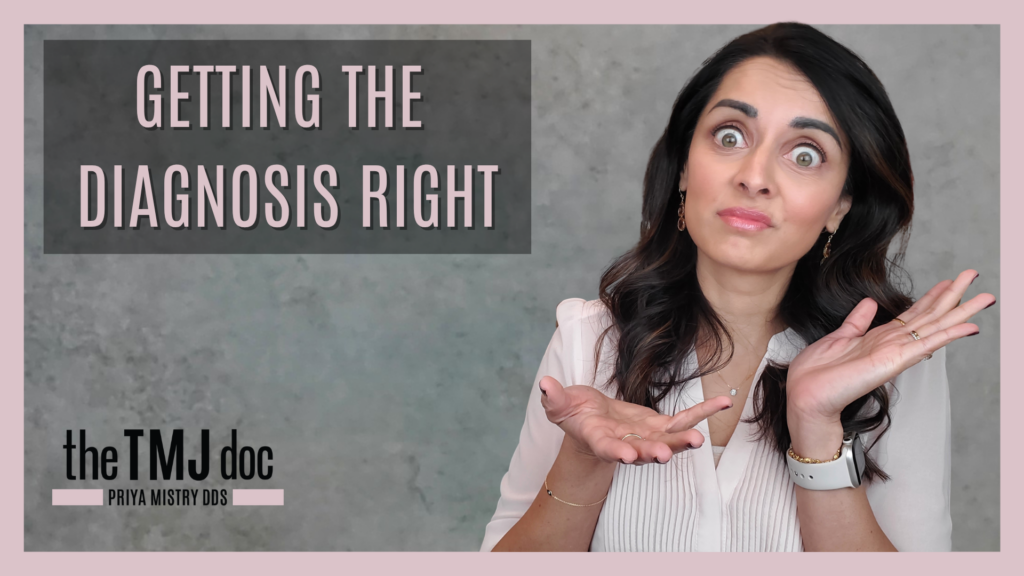
In this episode of Unclenched, Dr. Priya Mistry and Dr. Alex sit down with longtime neuromuscular dentist and educator Dr. Marty Frashetti for a deep conversation about one of the most important, and often overlooked, parts of treating TMJ disorders: getting the diagnosis right.
Dr. Frashetti has spent decades studying neuromuscular dentistry, orthodontics, functional appliances, occlusion, and TMD. His journey began shortly after graduating from dental school in 1984 and eventually led him to learn from and teach alongside some of the pioneers in the field.
Throughout the conversation, one message comes through again and again:
Symptoms are not the same thing as a diagnosis.
Looking Beyond the Symptoms
Jaw pain. Headaches. Muscle tenderness. Clicking. Limited opening. Ear symptoms. These can all be pieces of the puzzle, but identifying a symptom doesn’t necessarily explain why it is happening.
Dr. Frashetti explains that one of the biggest problems he sees isn’t necessarily misdiagnosis. It’s a lack of a comprehensive diagnosis altogether.
Instead of asking only, “Where does it hurt?” he encourages clinicians to keep working backward and ask:
What is creating the dysfunction in the first place?
That can mean looking beyond the jaw joint itself and considering skeletal development, the bite, airway, tongue function, muscles, posture, the cervical spine, and the relationship between the upper and lower jaws.
For patients with complicated TMD symptoms, that broader perspective can be incredibly important.
Treating the Body, Not Just the Jaw
One of the major themes of this episode is that TMJ treatment doesn’t exist in isolation.
Dr. Frashetti describes a comprehensive approach that evaluates postural, cranial, occlusal, maxillary, and mandibular dysfunction. Airway, tongue position and function, skeletal relationships, muscles, posture, and the bite can all potentially contribute to the bigger picture.
This is also why complex cases may require collaboration.
A patient’s care team might include a neuromuscular dentist, physical therapist, myofunctional therapist, chiropractor or other appropriately trained providers depending on what the evaluation reveals.
The goal isn’t to assume everything is caused by TMJ.
The goal is to understand how all of the pieces may be interacting.
Orthotics: Support vs. Long-Term Correction
Dr. Frashetti also makes an important distinction about orthotics.
An orthotic can be extremely valuable for supporting and stabilizing the jaw and muscles. But an orthotic itself doesn’t grow bone or permanently move teeth.
For some patients, that stabilization may be exactly what is needed. For others, it may be one part of a larger treatment process.
As Dr. Frashetti explains, the long-term goal of neuromuscular treatment is to create an environment where the body has the best opportunity to function physiologically rather than depending indefinitely on something compensating for an underlying problem.
That may mean addressing orthodontics, skeletal relationships, tongue function, airway, posture or other contributing factors when appropriate.
Why “Tunnel Vision” Can Be a Problem
Another fascinating part of the discussion focuses on what Dr. Frashetti calls “tunnel diagnosis.”
When every patient is evaluated through the lens of a particular appliance, technique or system, it becomes easy to start looking for problems that fit that treatment.
Instead, he encourages dentists to learn how to think diagnostically first.
Treatment should follow the diagnosis, not the other way around.
For Dr. Mistry, this philosophy closely reflects her own approach to TMD care: look at the entire patient, gather objective information, understand the dysfunction, and then determine which tools make sense for that individual.
Listener Question: “Why Won’t My Jaw Open?”
The episode also tackles a listener question about a jaw that suddenly won’t open normally.
Rather than immediately recommending an appliance or exercise, Dr. Frashetti starts with a much more fundamental question:
What is the diagnosis?
Limited opening could potentially involve the joint, muscles or other factors, and those possibilities may require very different approaches.
Simply resting the jaw or eating soft foods doesn’t necessarily answer the bigger question of why the jaw isn’t opening.
This is a perfect example of why diagnosis matters before treatment begins.
Listener Question: Can TMJ Treatment Help Tinnitus?
The conversation also explores one of the questions Dr. Mistry hears frequently: Can TMJ treatment help ringing in the ears?
The answer isn’t a simple yes or no.
The jaw, muscles and structures around the ear have important anatomical and neurological relationships, so TMD can sometimes be associated with tinnitus or ear fullness. But tinnitus can have many causes, which means it should never automatically be assumed to be a TMJ problem.
The doctors discuss several clues they consider, including whether the tinnitus is on one or both sides, whether it is constant or intermittent, how long it has been present, and whether moving or clenching the jaw changes its pitch or intensity.
When ear symptoms change with jaw movement, there may be a stronger reason to investigate a possible jaw-related component—but there are never guarantees.
What The TMJ Doc Wants You to Know
TMJ disorders are rarely as simple as finding the place that hurts and treating it.
Your jaw functions as part of a much larger system involving your muscles, teeth, bite, airway, tongue, neck, posture, skeletal structure, and nervous system.
That is why a thorough evaluation matters.
The question shouldn’t only be:
“How do we make this symptom go away?”
It should also be:
“Why is this happening?”
Understanding that difference can completely change the conversation around TMJ treatment.
In this episode of Unclenched, Dr. Priya Mistry, Dr. Alex, and Dr. Marty Frashetti unpack what comprehensive diagnosis really means, why symptoms don’t always tell the whole story, and why continuing education and collaboration are so important when treating complex TMD patients.
Listen to the full episode of Unclenched to hear the complete conversation.