You did what you were supposed to do.
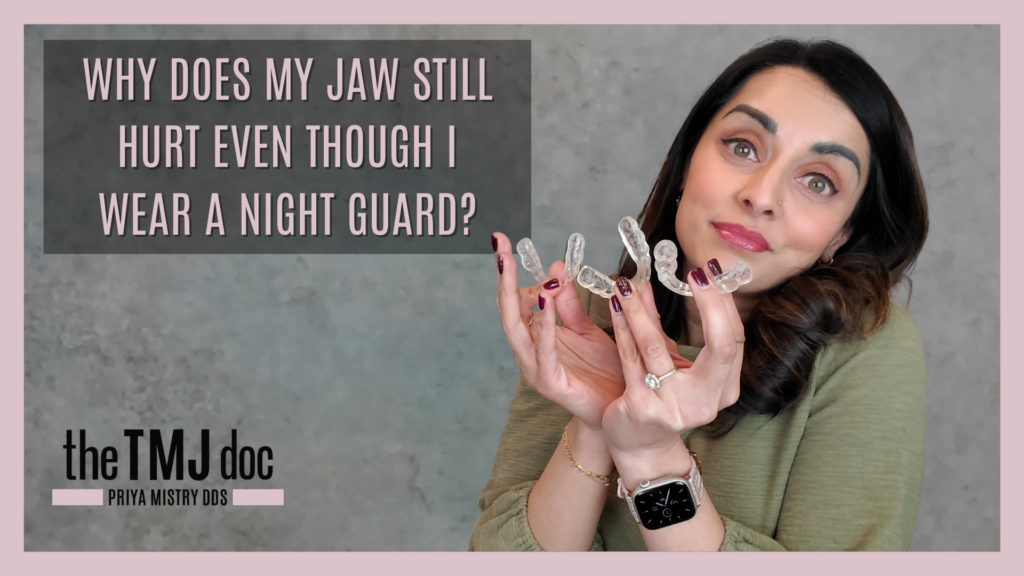
Your dentist told you that you were grinding or clenching your teeth, so you got a night guard.
You wear it every night.
Your teeth are protected.
But you still wake up with a sore jaw.
Maybe you still have headaches. Your face feels tight. Your neck hurts. Your ears feel full. Your jaw clicks or pops.
Or maybe you’ve noticed something even more confusing:
Your jaw actually feels worse after sleeping in your night guard.
So what’s going on?
Dr. Priya Mistry wants patients to understand an important distinction:
Protecting your teeth and treating TMD aren’t necessarily the same thing.
If you’re wearing a night guard and your symptoms aren’t improving, it may be time to look beyond the guard and ask why your jaw is hurting in the first place.
What Is Your Night Guard Designed to Do?
Traditional night guards can be very useful.
If you’re grinding your teeth, placing a protective appliance between your upper and lower teeth can help reduce direct tooth-to-tooth contact.
That may help protect against:
- Tooth wear
- Chipping
- Flattening of the teeth
- Damage to dental restorations
- Enamel loss
That’s important.
But notice what we’re talking about:
The teeth.
A traditional night guard is generally designed to protect your teeth from the effects of grinding.
It doesn’t necessarily tell us why you’re grinding or clenching.
And it doesn’t automatically mean the jaw joints and muscles are functioning comfortably.
“But I’m Wearing My Night Guard. Why Am I Still Clenching?”
Because a night guard doesn’t necessarily stop you from clenching.
You can still activate your jaw muscles with an appliance between your teeth.
That’s an important distinction between grinding and clenching.
Grinding involves moving the teeth against each other.
Clenching can involve sustained contraction of the jaw muscles with very little movement at all.
A night guard can create a barrier between the teeth, but those muscles may still be working.
For someone experiencing TMD symptoms, Dr. Mistry wants to understand what those muscles are doing and why.
Signs Your Night Guard May Not Be Solving the Problem
If you’re comfortable in your night guard and it’s protecting your teeth, that’s great.
This isn’t about telling everyone to throw away their night guard.
But persistent symptoms deserve attention.
Talk with your dentist or a provider experienced in evaluating TMD if you continue experiencing:
- Morning jaw soreness
- Jaw pain
- Facial tightness
- Frequent headaches
- Neck tension
- Ear pain or pressure
- Ringing in the ears
- Clicking or popping
- Difficulty chewing
- Limited jaw opening
- Jaw locking
- A bite that feels different after removing your guard
The appliance may not necessarily be causing those symptoms.
But if you’re wearing something every night and continuing to hurt, that’s useful information.
Can a Night Guard Actually Make TMJ Pain Worse?
For some patients, an appliance may aggravate symptoms.
That doesn’t mean night guards are inherently bad.
The issue is that different appliances interact with the jaw differently.
The thickness, material, fit, design, and way your teeth contact the appliance can all affect how your jaw functions while you’re wearing it.
Some patients may also clench more heavily against certain appliances.
If you consistently wake up feeling worse after wearing your guard, don’t simply assume that’s normal.
And don’t assume you just need to “get used to it” indefinitely.
Tell your provider what’s happening.
Pain is information.
Why Jaw Position Matters
Your lower jaw isn’t held in place by your teeth alone.
The TMJs, muscles, ligaments, nervous system, and teeth all contribute to how the jaw moves and functions.
That’s why Dr. Mistry doesn’t evaluate TMD simply by looking at whether someone’s teeth are worn down.
She wants to know:
- How is the jaw moving?
- What are the muscles doing?
- How are the joints functioning?
- Where does the bite fit into the picture?
- Is the patient comfortable in the position where the teeth currently meet?
For certain TMD patients, understanding those relationships can be much more important than simply putting a protective layer over the teeth.
Your Muscles May Be Part of the Missing Piece
If you’ve ever clenched your teeth intentionally, you know how quickly you can feel muscles activate through your jaw and temples.
Now imagine doing that repeatedly throughout the night.
Those muscles can become tired and sore.
For some patients, excessive muscle activity may contribute to:
- Jaw fatigue
- Facial pain
- Temple headaches
- Neck discomfort
- Morning soreness
- A feeling that the jaw is constantly tight
This is one reason Dr. Mistry uses a comprehensive approach when evaluating TMD.
She isn’t just looking at the teeth.
She wants to understand the muscles too.
How Does Dr. Mistry Evaluate Jaw Function?
Every patient is different, so the evaluation depends on the individual’s symptoms and history.
Dr. Mistry may look at the jaw joints, muscles, bite, range of motion, clenching patterns, and other factors that could be contributing to the problem.
When appropriate, technology can provide additional information.
TENS
TENS, or transcutaneous electrical nerve stimulation, may be used to help relax overworked jaw and neck muscles.
This can be particularly useful when muscles have spent a long time clenching or compensating.
Jaw Tracking
Jaw tracking allows Dr. Mistry to gather information about how the jaw moves during opening and closing.
Is the movement smooth?
Does the jaw deviate?
What happens as the teeth come together?
That information can help build a more complete picture of jaw function.
Muscle Activity
Electromyography, or EMG, can provide information about activity in certain muscles involved in jaw function.
Rather than simply guessing whether the muscles are working excessively, objective measurements can provide another piece of the puzzle.
The technology isn’t the treatment.
It’s information used to help understand the patient.
Could Your Nighttime Clenching Be Related to Sleep?
This is a question that often surprises patients.
If you’re clenching at night, Dr. Mistry may also want to know what’s happening with your sleep and breathing.
- Do you snore?
- Do you wake up frequently?
- Do you wake with a dry mouth?
- Are you exhausted during the day?
- Do you wake with headaches?
- Has anyone noticed that you stop breathing, gasp, or choke during sleep?
Nighttime clenching and sleep-disordered breathing can occur together in some patients.
That doesn’t mean everyone who clenches has sleep apnea.
But when other warning signs are present, simply giving someone a night guard without asking questions about sleep may leave an important area unexplored.
Why Would Breathing Affect the Jaw?
Your jaw and airway have a close anatomical relationship.
Jaw position and tongue position can influence the space available in the upper airway.
During sleep, breathing patterns and muscle activity also change.
Research has identified relationships between sleep bruxism and sleep-related breathing events in some people, although that relationship is complex and doesn’t mean one automatically causes the other.
For Dr. Mistry, the takeaway is simple:
If a patient is clenching at night and also showing signs of a possible sleep or airway problem, it’s worth investigating.
Sometimes that means involving a sleep physician or another healthcare provider.
A Night Guard and a TMJ Orthotic Aren’t Necessarily the Same Thing
They may both look like pieces of plastic that fit over your teeth.
But their purpose can be very different.
A traditional night guard is generally intended to protect the teeth.
A neuromuscular orthotic used in TMD treatment is created as part of a larger treatment process involving evaluation of the patient’s jaw, muscles, joints, and bite.
The difference isn’t simply what the appliance looks like.
It’s why it was made, how it was designed, what information was used to create it, and how the patient is monitored while wearing it.
An orthotic isn’t automatically appropriate for everyone with jaw pain.
Diagnosis comes first.
Don’t Buy Your Way Through a Drawer Full of Mouthguards
This happens more often than you might think.
A patient has jaw pain.
They buy a night guard.
It doesn’t work.
They try a softer one.
Then a thinner one.
Then an over-the-counter guard.
Then another custom appliance.
Eventually, there’s a drawer full of mouthguards and the same sore jaw.
At some point, the question shouldn’t be:
“Which mouthguard should I try next?”
It should be:
“Why does my jaw keep hurting?”
That’s a very different conversation.
What If My Night Guard Is Working?
Then that’s good news.
Not every patient with a night guard needs TMD treatment.
If your guard is comfortable, your teeth are protected, you aren’t experiencing significant jaw symptoms, and your dentist is monitoring you, there may be no reason to change what’s working.
The purpose of this conversation isn’t to make patients afraid of night guards.
It’s to understand their limitations.
The right appliance depends on the problem you’re trying to solve.
What The TMJ Doc Wants You to Know
If you’ve been wearing a night guard and your jaw still hurts, don’t assume that means you need a thicker night guard.
And don’t assume you simply have to live with it.
A night guard can protect your teeth without necessarily addressing why your jaw muscles, joints, or surrounding structures are uncomfortable.
Pay attention to what your body is telling you.
- Do you wake up sore?
- Are your headaches continuing?
- Does your face feel tight?
- Is your jaw clicking more?
- Are you clenching against the appliance?
- Are you sleeping poorly?
- Do you snore?
- Has your bite started feeling different?
Those details matter.
Dr. Priya Mistry takes a comprehensive approach to TMD because treating jaw pain requires understanding more than what’s happening to the surfaces of your teeth.
Sometimes a night guard is exactly what a patient needs.
Sometimes it’s only protecting the evidence of a larger problem.
And sometimes the most important question isn’t:
“Do I need a night guard?”
It’s:
“Why am I clenching in the first place?”
If you’ve been faithfully wearing your night guard but you’re still waking up with jaw pain, headaches, facial tension, or other TMD symptoms, a comprehensive evaluation may help determine what the guard isn’t telling you.