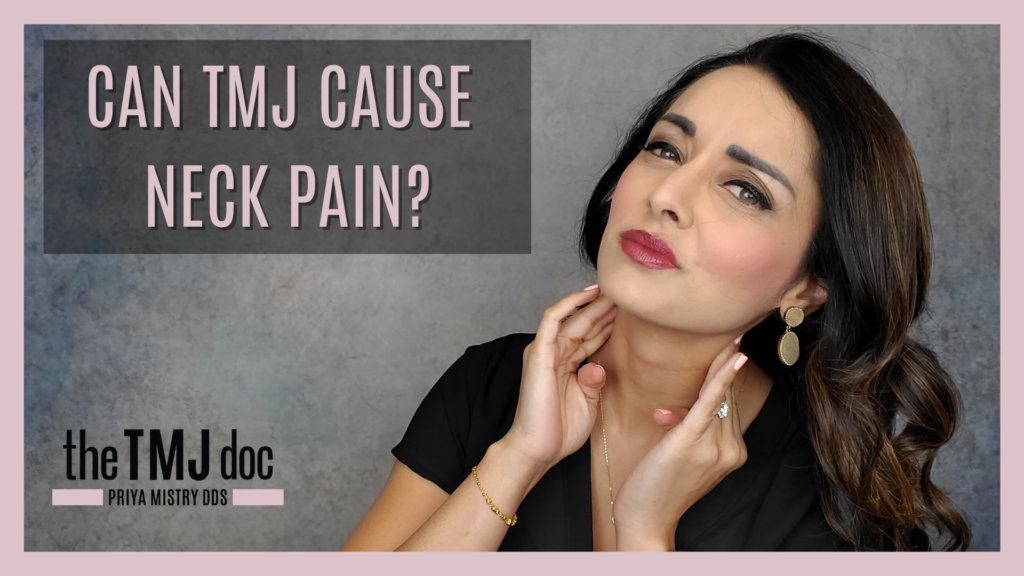
Your neck hurts.
So you stretch it.
You change your pillow. You get a massage. Maybe you see a chiropractor or physical therapist.
It feels better for a little while.
Then the tightness comes back.
If you’re also experiencing jaw pain, headaches, clenching, grinding, or facial tension, there may be another part of the picture worth investigating:
Your jaw.
The temporomandibular joints, or TMJs, don’t function independently from the rest of your body. The jaw, muscles of the head and neck, and cervical spine work closely together.
For some patients, that means a problem involving the jaw can show up as symptoms in the neck.
And sometimes, problems involving the neck can affect the jaw.
Your Jaw and Neck Work Together
Your head is heavy.
And throughout the day, a complex system of muscles works constantly to keep it balanced over your neck and shoulders.
Many of those muscles interact, directly or indirectly, with the muscles involved in jaw function.
That’s why Dr. Priya Mistry doesn’t look at the jaw as an isolated hinge.
When evaluating a patient with TMD, she wants to understand what’s happening with the jaw joints, muscles, bite, head position, neck, and posture.
If one part of that system is working harder than it should, another area may begin compensating.
Over time, those compensations can contribute to tension and discomfort.
What Does TMJ-Related Neck Pain Feel Like?
Every patient is different.
Some people have obvious jaw pain and neck pain at the same time.
Others come in complaining primarily about headaches, shoulder tension, or a stiff neck and don’t initially realize their jaw may be worth evaluating.
Symptoms that can occur alongside TMD include:
- Neck pain or stiffness
- Tight shoulders
- Pain near the base of the skull
- Frequent headaches
- Facial tension
- Jaw soreness
- Clicking or popping in the jaw
- Difficulty opening comfortably
- Pain while chewing
- Clenching or grinding
- Ear pain or pressure
- A tired or heavy feeling in the jaw muscles
Having neck pain doesn’t automatically mean you have TMD.
But when several of these symptoms occur together, looking at the jaw may provide another useful piece of information.
Why Can Jaw Problems Affect the Neck?
Think about what happens when you clench your teeth.
Go ahead and gently clench for a second.
You probably don’t feel that contraction only in your teeth.
You may feel muscles activate through your jaw, temples, face, and even into your neck.
Now imagine doing that repeatedly throughout the day or for hours while you’re sleeping.
That’s a lot of work.
Clenching and grinding can increase activity in the jaw muscles, and for some patients, that tension is accompanied by tightness through the head, neck, and shoulders.
The opposite can also happen.
If your neck is uncomfortable or your head posture changes, the jaw may adapt to what’s happening above and below it.
That’s why the relationship isn’t always as simple as:
“My TMJ caused my neck pain.”
Sometimes it’s better to ask:
“How are my jaw and neck influencing each other?”
What Does Posture Have to Do With TMJ?
Quite a bit.
Look around almost any coffee shop, office, airport, or waiting room.
Heads are down.
Shoulders are rounded.
People are leaning toward laptops and staring at phones.
When your head repeatedly moves forward from a more neutral position, the muscles supporting your head and neck have to adapt.
For someone already experiencing TMD, that additional muscle strain may aggravate symptoms.
Dr. Mistry frequently sees patients with forward head posture, where the head sits farther forward relative to the shoulders.
That doesn’t mean poor posture automatically causes TMD.
But posture can be another piece of the puzzle, especially when neck pain, headaches, muscle tension, and jaw symptoms are happening together.
The Airway May Be Part of the Conversation Too
Posture isn’t always simply a bad habit.
For certain patients, Dr. Mistry also considers breathing and airway function.
Some people may adopt different head or neck positions in response to breathing challenges.
That’s one reason simply telling every patient to “sit up straight” may not address the complete picture.
- Why is the head forward?
- What’s happening with the jaw?
- Where is the tongue?
- How is the patient breathing?
- What happens while they’re sleeping?
- Are they snoring?
- Are they waking up rested?
The goal isn’t to assume every postural problem is an airway problem.
It’s to understand why the patient is holding their body the way they are.
Why Does My Neck Feel Better After Treatment, Then Hurt Again?
This is something patients often find incredibly frustrating.
- Massage helps.
- Stretching helps.
- An adjustment helps.
- Physical therapy helps.
- But eventually, the tightness returns.
That doesn’t necessarily mean those treatments aren’t working.
It may mean another contributing factor hasn’t been identified yet.
If the jaw muscles, bite, clenching patterns, or TMJs are contributing to the tension, treating only the neck may not address the entire situation.
The same is true in reverse.
Treating the jaw without paying attention to significant neck dysfunction may leave an important piece of the puzzle untouched.
For some patients, the best approach is collaborative.
Headaches Can Be Part of the Same Picture
Jaw pain and neck pain frequently aren’t the only complaints Dr. Mistry hears.
There are often headaches too.
The muscles around the jaw, temples, neck, and base of the skull can all become tense or overworked.
That can make it difficult for patients to know exactly where their symptoms are beginning.
- Is it the neck?
- The jaw?
- The muscles?
- Something else entirely?
That’s why recurring headaches shouldn’t automatically be labeled as a TMJ problem.
But if your headaches consistently occur alongside jaw soreness, clenching, grinding, facial pain, neck tension, or limited jaw movement, evaluating the jaw may be worthwhile.
How Does Dr. Mistry Evaluate the Jaw-Neck Connection?
A comprehensive TMD evaluation involves much more than asking whether your jaw clicks.
Dr. Mistry looks at how the entire jaw system is functioning.
Depending on the patient, that may include evaluating:
- Jaw movement and range of motion
- Muscle tenderness and activity
- The TMJs themselves
- Clenching and grinding patterns
- The bite
- Head and neck posture
- Areas of muscular compensation
- Headache patterns
- Breathing and airway concerns
- Sleep-related symptoms
Technology can also provide additional information about muscle activity and jaw movement when appropriate.
The goal is to build a clearer picture of how the system is functioning together.
Does Treating TMD Fix Neck Pain?
Not necessarily.
Neck pain can have many causes, including injuries, arthritis, disc problems, muscle strain, neurological conditions, and other medical issues.
TMD treatment isn’t a replacement for appropriate medical evaluation of neck pain.
But when jaw dysfunction appears to be contributing to the overall pattern, addressing the jaw may be one component of care.
That’s an important distinction.
Dr. Mistry isn’t trying to make every symptom a TMJ symptom.
She’s trying to identify which symptoms may actually be connected.
Why Collaborative Treatment Can Matter
Sometimes the jaw isn’t the only area that needs attention.
A patient may benefit from working with more than one provider.
Depending on the individual situation, that could include a:
- Physical therapist
- Upper cervical chiropractor
- Massage or myofascial therapist
- Sleep physician
- ENT
- Craniosacral therapist
- Other medical provider
Each professional looks at the problem through a different lens.
Dr. Mistry’s job isn’t necessarily to treat every part of the body herself.
It’s to recognize when something outside the jaw may be affecting treatment and when another provider should become part of the team.
What Can You Do at Home?
If you’re dealing with mild jaw and neck tension, small changes may help reduce unnecessary strain.
Pay attention to where your head is while working.
Bring screens closer to eye level instead of constantly looking downward.
Notice whether you’re clenching your teeth while concentrating, driving, exercising, or scrolling on your phone.
Give your jaw opportunities to relax.
Heat may also feel soothing for tight jaw and neck muscles, and gentle movement can help some people with stiffness.
But persistent pain shouldn’t simply become something you learn to live with.
If the symptoms keep returning, it’s worth finding out why.
When Should Neck Pain Be Evaluated Medically?
Neck pain isn’t always muscular, and it isn’t always related to TMD.
Seek appropriate medical care for significant or worsening neck pain, particularly when it’s associated with symptoms such as:
- Weakness in an arm or hand
- Persistent numbness or tingling
- Significant loss of coordination
- Severe pain following an injury
- Fever or unexplained illness
- New neurological symptoms
- Sudden or unusually severe headache
Those symptoms deserve medical evaluation rather than assuming the jaw is responsible.
What The TMJ Doc Wants You to Know
Your jaw isn’t floating by itself in the middle of your head.
It’s part of a much larger system.
Your jaw joints, muscles, neck, posture, breathing, and bite can all influence how that system functions.
That’s why chronic neck pain deserves more than automatically assuming you need a better pillow or another massage.
If your neck pain keeps returning and you’re also experiencing jaw pain, headaches, facial tension, clenching, grinding, clicking, or limited jaw movement, your TMJs may be worth evaluating.
The goal isn’t to blame everything on your jaw.
It’s to stop looking at every symptom as though it exists completely on its own.
Dr. Priya Mistry takes a comprehensive approach to TMD because sometimes the place that hurts isn’t the only place that needs to be investigated.
If your neck keeps telling you something isn’t right, your jaw may be worth listening to as well.