“I already have a night guard. Why does my jaw still hurt?”
Dr. Priya Mistry hears versions of this question all the time.
A patient has jaw pain, headaches, facial tension, or clenching. Their dentist notices they’re grinding their teeth and makes them a night guard.
They wear it faithfully.
Their teeth may be protected.
But their jaw still hurts.
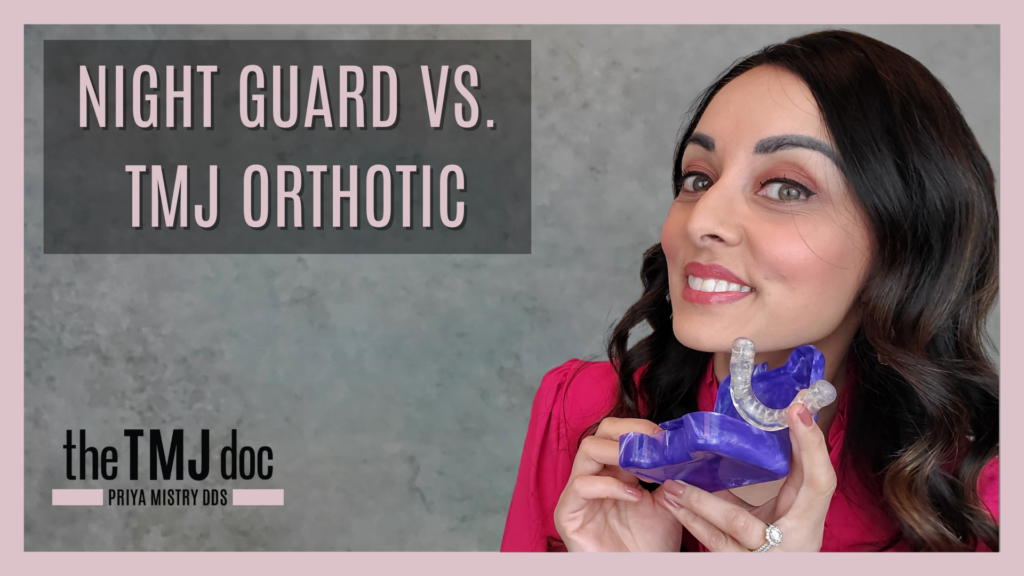
That’s because a night guard and a neuromuscular orthotic may look somewhat similar, but they aren’t necessarily designed to do the same job.
Understanding that difference can be incredibly important for someone dealing with TMD.
What Does a Night Guard Actually Do?
Let’s start with the traditional night guard.
A night guard is typically a removable appliance worn over the teeth, most often while sleeping.
Its primary job is exactly what the name suggests:
It guards your teeth.
If you grind your teeth at night, having a protective layer between the upper and lower teeth may help reduce wear, chipping, or other damage caused by tooth-to-tooth contact.
And for some patients, that’s exactly what they need.
The important distinction is that protecting your teeth from grinding and treating a TMJ disorder aren’t necessarily the same thing.
If your only issue is tooth wear, a night guard may be appropriate.
But if you’re experiencing jaw pain, headaches, facial pain, clicking, locking, limited movement, or other TMD symptoms, Dr. Mistry wants to understand much more than whether you’re grinding your teeth.
A Night Guard Doesn’t Automatically Treat TMD
This is where things can become confusing.
Patients are sometimes given a night guard because they’re clenching or grinding and assume that means they’re receiving TMJ treatment.
Not necessarily.
Think of it this way:
If you’re wearing down the soles of your shoes because of the way you’re walking, putting a tougher sole on the shoe may protect it.
But it doesn’t necessarily explain why you’re walking that way.
The same principle can apply to your teeth.
A night guard can create a barrier between your teeth.
But if your jaw joints and muscles aren’t functioning comfortably, simply putting material between the teeth may not address the larger problem.
For some TMD patients, Dr. Mistry needs to understand where the jaw is functioning most comfortably, not simply protect the teeth in their existing position.
So What Is a Neuromuscular Orthotic?
A neuromuscular orthotic is a custom dental appliance used as part of treatment for certain patients with TMD.
Unlike a basic protective night guard, the orthotic is created using information gathered during a comprehensive evaluation of the patient’s jaw.
The goal is to support the jaw in a position where the muscles and joints can function more comfortably.
That distinction matters.
- A night guard is generally designed around the teeth.
- A neuromuscular orthotic is designed around the function of the jaw system.
And determining that position shouldn’t simply involve guessing where the jaw looks like it belongs.
How Does Dr. Mistry Determine Where Your Jaw Should Be?
This is one reason Dr. Mistry uses technology as part of her TMD evaluations.
She isn’t only asking:
“Where do your teeth fit together?”
She also wants to know:
“What are your muscles and jaw doing?”
Depending on the individual patient, neuromuscular evaluation can include technologies and techniques that provide information about jaw movement and muscle activity.
TENS
TENS, or transcutaneous electrical nerve stimulation, may be used to help relax overworked jaw and neck muscles.
When muscles have been clenching and compensating for a long time, the habitual position of the jaw may not necessarily be its most comfortable position.
Relaxing those muscles can provide additional information during the evaluation.
Jaw Tracking
Jaw tracking technology allows Dr. Mistry to evaluate how the jaw moves.
- How does it open?
- How does it close?
- Does it deviate?
- What happens during movement?
Instead of relying only on what the jaw looks like from the outside, tracking provides objective information about how it is functioning.
Muscle Activity
Electromyography, or EMG, can provide information about the activity of certain muscles involved in jaw function.
This gives Dr. Mistry another piece of information when evaluating how the bite, muscles, and jaw may be interacting.
The important point isn’t the technology itself.
It’s what the technology helps Dr. Mistry understand.
Your treatment should be based on information about your jaw, not simply the fact that your teeth show signs of grinding.
When Might a Night Guard Be Enough?
Not everyone who grinds their teeth needs a neuromuscular orthotic.
If you have tooth wear but aren’t experiencing significant jaw symptoms, a traditional night guard may be an appropriate way to protect your teeth.
For example, someone may have:
- Evidence of grinding or tooth wear
- Little or no jaw pain
- No significant headaches or facial pain
- Comfortable jaw movement
- No locking or significant limitation
- A bite that feels stable
In that situation, protection may be the primary goal.
The question changes when other symptoms begin appearing.
When Should You Look Beyond a Night Guard?
If you’re wearing a night guard but still experiencing symptoms, it may be worth taking a closer look at the TMJs, muscles, and bite.
Symptoms Dr. Mistry pays attention to include:
- Persistent jaw pain
- Morning headaches
- Facial pain or tension
- Neck tension
- Clicking or popping
- Jaw locking
- Difficulty opening your mouth
- Pain while chewing
- Ear pain or pressure
- A bite that suddenly feels different
- Waking up with significant jaw soreness
- Symptoms that haven’t improved despite wearing a night guard
One symptom alone doesn’t automatically mean you need an orthotic.
But persistent or multiple symptoms are a reason to investigate why they’re happening.
“But My Night Guard Makes Me Feel Better”
Great.
If you’re comfortable, your symptoms are controlled, your teeth are protected, and your dentist is monitoring you, there may be no reason to change something that’s working.
The message isn’t: Night guards are bad.
It’s: Night guards and TMJ orthotics have different purposes.
The right appliance depends on the problem you’re trying to solve.
“My Night Guard Makes My Jaw Feel Worse”
That’s something worth discussing with your dentist or a provider experienced in evaluating TMD.
If you consistently wake up with more jaw pain, headaches, muscle soreness, or changes in the way your teeth come together after wearing an appliance, don’t simply assume you need to “get used to it.”
An appliance changes the way your upper and lower teeth interact.
For someone with an already sensitive jaw system, those changes can matter.
Your symptoms are information.
Pay attention to them.
Why Clenching Makes This More Complicated
People often assume grinding is the entire problem.
But grinding and clenching aren’t exactly the same thing.
Grinding involves movement of the teeth against each other.
Clenching can involve sustained muscle contraction without much movement at all.
A guard may protect the teeth from contacting each other directly, but you’re still capable of activating your jaw muscles while wearing it.
That’s why Dr. Mistry looks beyond the question:
“Are you grinding?”
She wants to understand what’s happening with the muscles, joints, bite, and overall function of the jaw.
An Orthotic Isn’t Just a Fancy Night Guard
This is probably the biggest misconception.
Patients sometimes look at a TMJ orthotic and think: “That looks like a mouthguard. Why is this different?”
The difference isn’t simply the material.
It’s the diagnosis, measurements, design, purpose, and follow-up behind the appliance.
A therapeutic orthotic is one component of a larger treatment process.
That process may involve evaluating symptoms, relaxing muscles, measuring jaw function, creating the appliance, monitoring how the patient responds, and making adjustments as treatment progresses.
The appliance isn’t the entire treatment.
It’s a tool being used as part of the treatment.
What Happens After Orthotic Therapy?
This depends entirely on the patient.
For some patients, an orthotic may be used as part of an initial phase of treatment while Dr. Mistry evaluates how the jaw responds.
From there, the next step depends on the individual’s symptoms, bite, anatomy, goals, and response to treatment.
Some patients may continue with an appliance.
Others may eventually consider orthodontic or restorative options.
And some may need collaboration with other healthcare professionals, such as a physical therapist, upper cervical chiropractor, sleep physician, ENT, or another provider.
There isn’t one universal TMJ treatment plan.
That’s why the evaluation comes first.
What The TMJ Doc Wants You to Know
A night guard and a TMJ orthotic are not interchangeable just because they both fit over your teeth.
A night guard can be an excellent tool when the goal is protecting teeth from grinding.
But if you’re experiencing chronic jaw pain, headaches, facial tension, clicking, locking, ear symptoms, or changes in your bite, protecting the teeth may only be one piece of the puzzle.
Dr. Mistry wants to know why you’re having those symptoms in the first place.
- What are the muscles doing?
- How are the joints functioning?
- How does your jaw move?
- Where does your bite fit into the picture?
- And most importantly:
- Is the appliance you’re wearing actually helping you feel and function better?
If you’ve been wearing a night guard and you’re still waking up with jaw pain, headaches, facial tension, or other TMD symptoms, it may be time for a more comprehensive evaluation.
Because protecting your teeth is important.